How Long Is a Wedding Ceremony? A Realistic Timing Guide
Quick answer: A typical wedding ceremony lasts 20 to 30 minutes, though civil ceremonies can run as short as 10 minutes and religious ceremonies with full rites can stretch to 45-60 minutes. The right length depends on your ceremony type, number of readings or rituals, and whether guests are standing or seated.
Key takeaways
- Most wedding ceremonies run 20 to 30 minutes, covering a welcome, readings, vows, ring exchange, and pronouncement.
- Civil ceremonies typically take 10 to 20 minutes since they only need the legal essentials, according to Brides and Plan A Wedding.
- Religious ceremonies with hymns, prayers, and communion often run 30 to 60 minutes.
- Processionals alone can take 5 to 8 minutes once you count grandparents, the wedding party, and the couple’s entrance.
- New Jersey generally has a 72-hour waiting period after you apply before the marriage license is issued, so confirm the timing with your local registrar, according to the New Jersey Department of Health.
What Is the Average Wedding Ceremony Length?
Most wedding ceremonies run between 20 and 30 minutes. That window is long enough to cover the basics, a welcome from the officiant, a reading or two, your vows, the ring exchange, and the final pronouncement, without losing your guests’ attention, according to Brides.
That average holds up across a lot of different wedding styles, but it is only a starting point. A short civil ceremony at a courthouse can be over in ten minutes. A full religious service with communion or multiple rituals can run close to an hour. The right length for your day depends on your ceremony type, your traditions, and how many personal touches you want to build in.
FNA Events serves weddings across New Jersey, New York, and the Philadelphia area. Ceremony timing usually comes down to the format, processional size, number of readings, and any religious or cultural rituals involved.
How Long Is a Civil Wedding Ceremony?
Civil ceremonies, whether performed at a courthouse, registry office, or by an officiant at your venue, are typically the shortest format. They often run 10 to 20 minutes because the format is concise, commonly including a welcome, a declaration of intent, vows, an optional ring exchange, and the pronouncement.
If you are marrying in New Jersey, a civil ceremony requires a valid marriage license. The New Jersey Department of Health says there is generally a 72-hour waiting period after the application is filed before the license is issued, so contact the appropriate local registrar with enough time to complete the process and confirm current requirements.
Civil ceremonies work well for couples who want a quick, no-frills legal moment, sometimes followed by a longer celebration or reception later. If you want an officiant who can also build in personal vows or readings, FNA Events’ wedding officiant services can help you customize a civil or secular ceremony without stretching it too long.
How Long Is a Religious Wedding Ceremony?
Religious ceremonies tend to run the longest of any format, typically 30 to 60 minutes, because they often include hymns, prayers, a sermon or homily, and sometimes communion or other sacramental elements, according to Plan A Wedding.
A Catholic nuptial Mass is generally longer than a ceremony without Mass. Protestant and Jewish ceremony lengths vary widely based on the congregation, clergy, music, readings, and included traditions; for Jewish weddings, the ketubah signing may also take place before the public ceremony.
If you are planning a Jewish, Catholic, or other faith-based ceremony with specific rituals, talk to your officiant or clergy early about which elements are required versus optional. That conversation shapes your ceremony length more than almost any other decision.
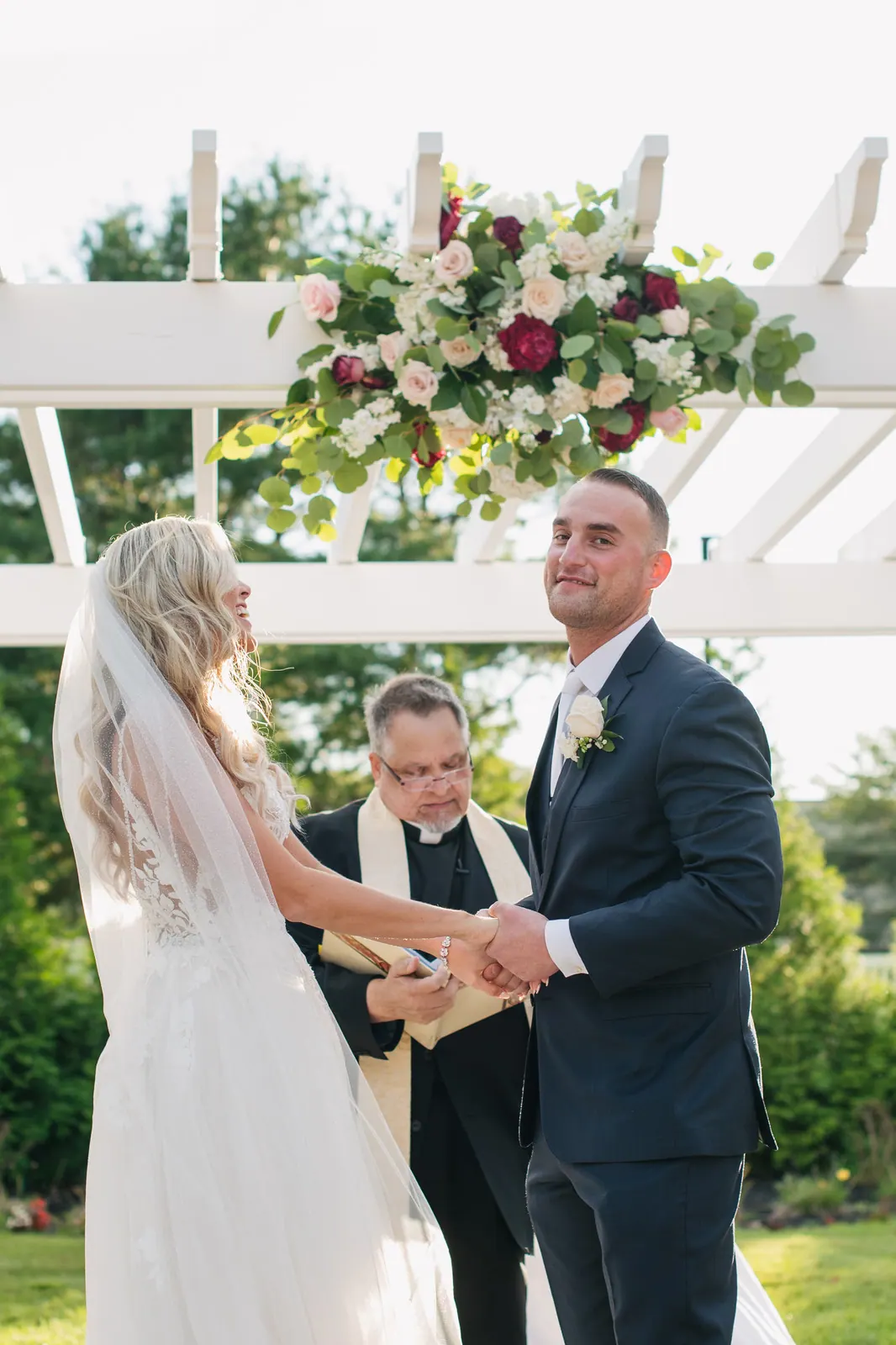
How Long Is a Secular or Non-Denominational Ceremony?
Secular and non-denominational ceremonies usually fall in the middle, running 20 to 35 minutes. These ceremonies are built around personalized elements the couple chooses, rather than a fixed religious script, which gives you flexibility but also means you are responsible for filling the time with meaningful content, according to Plan A Wedding.
A micro-wedding or elopement ceremony can be as short as 5 to 10 minutes if you strip it down to vows and a ring exchange with no readings or extended processional.
Couples planning intimate or micro weddings in New Jersey often lean into this shorter format intentionally, using the time saved for more cocktail hour or photos instead. If that sounds like your plan, our guide on whether a DJ is worth it for a small wedding covers how entertainment fits into a scaled-down day.
Ceremony Timeline Breakdown: Processional, Readings, Vows, and Rituals
Once you know your ceremony type, the next step is estimating each individual segment. Here is a realistic breakdown based on typical timing for each part of a wedding ceremony, based on the elements you plan to include.
| Ceremony Element | Typical Time | Notes |
|---|---|---|
| Seating of grandparents and parents | 2 to 3 minutes | Add extra time for larger families or multiple sets of parents |
| Wedding party processional | 1 to 3 minutes | Roughly 15 to 20 seconds per pair walking down the aisle |
| Flower girl and ring bearer | 30 seconds to 1 minute | Build in buffer time since children are unpredictable |
| Couple’s entrance | 1 to 2 minutes | A longer aisle or slower walking pace may require more time |
| Welcome and opening remarks | 2 to 4 minutes | Officiant sets the tone and shares the couple’s story |
| Readings | 2 to 4 minutes each | Add 2 to 4 minutes for every reading included |
| Vows (personal or traditional) | 1 to 3 minutes each | Traditional prompted vows run shorter than personal vows |
| Ring exchange | 2 to 3 minutes | Includes officiant’s words during the exchange |
| Unity ritual | 3 to 7 minutes | Candle lighting, sand ceremony, handfasting, or similar |
| Pronouncement and recessional | 2 to 4 minutes | Couple exits first, then wedding party, then parents |
If you are writing your own vows, keep an eye on length so both partners land in a similar range. Our guide on how to write your own wedding vows walks through pacing and length in more detail.
What Makes a Ceremony Run Longer or Shorter?
A few factors move your ceremony length more than anything else. Knowing them ahead of time helps you set realistic expectations with your officiant, photographer, and entertainment team.
- Processional size: More family members and wedding-party participants walking down the aisle can make the processional longer.
- Number of readings and rituals: Each additional reading or unity ritual, such as a sand ceremony or candle lighting, adds several minutes.
- Officiant style: Some officiants keep remarks brief; others weave in longer stories or reflections about the couple.
- Live music or musical interludes: A musical performance mid-ceremony, such as a soloist or instrumental piece, typically adds 3 to 5 minutes per song.
- Cultural or religious traditions: Multicultural ceremonies that blend two traditions, or Jewish ceremonies with a full chuppah service, naturally run longer than a single-tradition secular ceremony.
Couples blending traditions often add live musicians for specific cultural moments. FNA Events offers live wedding musicians, including saxophone, electric violin, percussion, and ceremony strings. Ask which instruments and coverage options best fit your entrance, exit, and cocktail-hour plans.
How Ceremony Length Affects Your Wedding Day Schedule
Your ceremony length is just one piece of the full wedding day timeline, but it has a ripple effect on everything that follows. A longer religious ceremony can push back cocktail hour, photos, and your reception start time, especially if your ceremony and reception are at different venues and require travel time.
Here is a simple way to build backward from your reception start time:
- Confirm your reception start time with your venue and vendors.
- Subtract cocktail hour (typically 60 minutes) and any travel time between ceremony and reception venues.
- Subtract your estimated ceremony length based on the table above.
- Subtract another 15 to 30 minutes for guest seating and a pre-ceremony buffer.
- Work backward further to set your getting-ready and photo timeline.
If your ceremony and reception are in different locations, especially for shore weddings with travel between a beach ceremony and an indoor reception, build in more buffer than you think you need. Our guide on handling timeline delays covers how to keep your day on track when something runs long.
Once you have your ceremony length locked in, you can move on to planning the rest of the day. Our guide to wedding reception length picks up right where this one leaves off.
Standing vs. Seated Ceremonies: Does It Change the Length?
Ceremony format affects how long guests can comfortably wait, even if it does not change the script itself. If you are having a standard-length ceremony with seating for every guest, you have more flexibility to run 25 to 30 minutes or longer.
If guests will be standing, such as at a small beach ceremony or a cocktail-style event, consider keeping the ceremony to about 10 minutes or less, as Brides suggests, and provide chairs for anyone who cannot comfortably stand for that long. Even with a standing format, it is a good idea to have a few chairs available near the front for anyone who needs them.
This matters especially for Jersey Shore ceremonies on sand, where uneven footing adds to the challenge of a long standing ceremony. Our beach wedding planning checklist covers seating, permits, and other shore-specific logistics in more detail.
Frequently Asked Questions
How long should a wedding ceremony be for a small or intimate wedding?
A micro-wedding or elopement ceremony can be as short as 5 to 10 minutes when it includes only the vows, ring exchange, and pronouncement. Many couples with smaller guest lists skip extra readings or a long processional since there is no large wedding party to seat or walk down the aisle.
Is 15 minutes too short for a wedding ceremony?
No, 15 minutes is a normal length for a civil or simple secular ceremony. It easily covers a welcome, vows, ring exchange, and pronouncement. It only feels too short if guests expect more readings, rituals, or a longer processional based on the wedding’s formality.
How long should the processional music be for a wedding?
Plan for 5 to 8 minutes of processional music to cover parents and grandparents being seated, the wedding party entering, and the couple’s entrance. Choose songs with natural pause points or loop sections so the music does not cut off abruptly if the walk takes longer than expected.
Can a wedding ceremony be too long?
Yes. A ceremony can feel too long when its content, seating, or weather conditions make guests uncomfortable or disengaged, especially at outdoor or standing ceremonies. If your religious or cultural ceremony naturally runs long, let guests know in advance so they can plan accordingly, and provide shade, water, or seating when possible.
Does the ceremony length affect how long I need a DJ or musicians?
Yes. Ceremony-music coverage windows vary by performer and package, so confirm that the booked time includes any prelude music, the processional, the ceremony itself, and the recessional. If your ceremony runs longer due to extra rituals, let your musicians and DJ know in advance so they can plan their set accordingly.
Sources
- How Long Is a Wedding Ceremony Supposed to Be? – Brides
- How long is a wedding ceremony? What to Include and What to Skip – AMM
- Marriage License – NJ Department of Health
Ready to Check Your Date
If you are planning a wedding or celebration in New Jersey, New York, or the Philadelphia area, the FNA Events team can walk you through DJ and MC entertainment, photography, videography, live music, enhancements, and photo booths, all run by one coordinated crew. Call (844) 373-7411 or visit our contact page to share your date and venue and get pricing for your celebration.
Written by the team at Fresh New Angle Events, Toms River, New Jersey wedding DJs, photographers, videographers, and event professionals serving couples across New Jersey, New York, and the Philadelphia area.