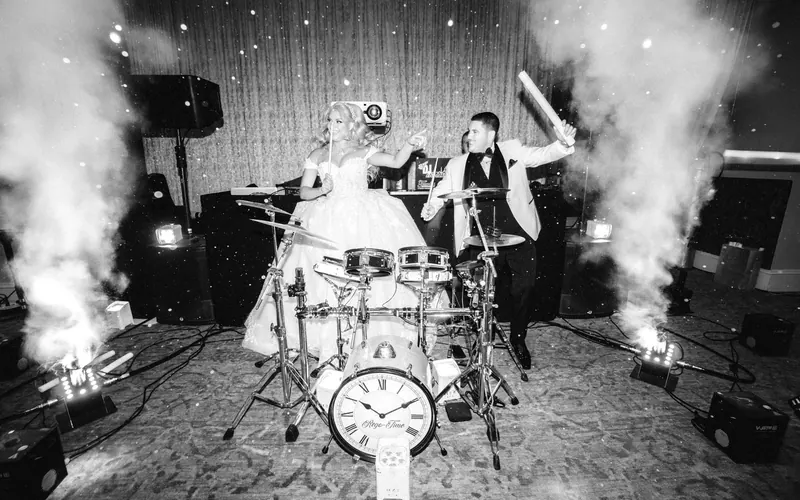
DJ Techniques for Reading and Energizing a Wedding Crowd

Quick answer: A wedding DJ reads a crowd by watching body language, dance floor density, and song reactions in real time, then adjusts tempo, genre, and transitions to keep energy building rather than stalling. Skilled DJs use layered playlists, planned peak moments, and flexible sets instead of a fixed, unchangeable song order.
Key takeaways
- A good DJ watches feet, faces, and the dance floor edges, not just requests, to judge real crowd energy.
- Energy building works in waves: warm-up, peak, breather, peak again, rather than one long high-intensity block.
- Opening songs should be familiar and easy to dance to, not obscure tracks meant to impress rather than include.
- Planned flexibility, not a rigid set list, is what lets a DJ recover from a slow moment or a request that doesn’t fit the room.
- Nonverbal cues like sustained dancing, raised arms, and group singalongs can signal that a peak moment is working.
What Does It Mean When a DJ “Reads the Crowd”?
Reading the crowd means a DJ is constantly watching how guests respond to the music and adjusting in real time instead of running through a fixed playlist. It is less about any single song and more about recognizing patterns: who is dancing, who is standing at the edges, and who just put down a drink to head for the floor.
FNA Events provides professional DJ and MC teams that can adjust the music and hosting as a reception unfolds. Coverage typically includes up to six hours of DJ and MC time on wedding packages, which gives a DJ enough runway to build energy gradually instead of rushing the dance floor open before guests are ready.
This is different from simply playing a pre-made playlist in order. A couple can absolutely hand over a must-play and do-not-play list, but a skilled DJ still has to decide when each song fits the room’s actual mood, not just its position on a page.
The Visual and Audio Cues DJs Actually Watch For
Experienced DJs rely on a handful of repeatable signals rather than guesswork. According to Pioneer DJ’s own guidance for performers, reading a room means watching faces, feet, hands, who is singing along, and who just walked off to get a drink, often without saying a word to anyone.
- Dance floor density: Is the floor filling in from the edges or thinning out toward the bar?
- Foot and hip movement among guests still seated, which often predicts who is about to join the floor.
- Singing along to lyrics, a strong signal a song is landing with the group as a whole.
- Sustained participation, such as raised arms, group singalongs, or more guests joining the floor, can indicate that a peak moment is working.
- Requests clustering around one genre or era, suggesting the current crowd skews toward a particular sound.
Industry guides, including tips published by DJ Tech Reviews, recommend DJs spend time observing the crowd before their set even starts, sometimes from the edge of the room, to understand what energy level the group is arriving with. A quieter, older crowd at a 4 p.m. ceremony start needs a different opening approach than a crowd arriving from an open bar cocktail hour at 8 p.m.
How DJs Build Energy in Waves, Not a Straight Line
One of the most common mistakes is treating energy building as one long climb to the loudest possible moment. In reality, most strong receptions move in waves: an easy opening, a climb to a first peak, a short breather, then another climb to an even bigger peak later in the night.
Skilled DJs often balance upbeat tracks with lower-intensity stretches to maintain momentum without exhausting the crowd. Running nonstop high-energy tracks for an extended stretch can tire guests and thin the dance floor before the last dance.
A Typical Wave Looks Like This
- Warm-up (the opening stretch of dancing): familiar, mid-tempo, broadly appealing songs that welcome every age group onto the floor.
- First peak: well-known, high-energy crowd-pleasers once the floor is full and confident.
- Breather: a slightly slower or more nostalgic stretch, sometimes paired with a planned moment like a parent dance or toast.
- Second peak: often the biggest of the night, timed around cake cutting, bouquet toss, or a planned anchor song.
- Wind-down: a final run that acknowledges the night is ending without abruptly killing the mood.
This structure is one reason timing matters so much. Our guide to building a NJ wedding reception timeline covers how these musical waves should line up with dinner service, toasts, and other reception milestones.
Music Flow Templates DJs Use to Keep Energy Moving
Most professional DJs work from a flexible framework rather than a locked song order. Below is a simplified template that mirrors how many wedding receptions actually flow, adjusted in real time based on crowd reaction.
| Reception Phase | Illustrative Timing | Music Goal | Example Approach |
|---|---|---|---|
| Cocktail hour | 45-60 minutes | Comfortable background energy | Light jazz, acoustic covers, or easy pop to support conversation, not dancing |
| Dinner | 45-75 minutes | Pleasant, unobtrusive | Mellow familiar tracks across decades, low volume for toasts and speeches |
| Floor opening | 15-20 minutes | Low-risk inclusion | Widely known songs that appeal to grandparents and teenagers alike |
| First peak | 20-30 minutes | High energy, full floor | Proven crowd-pleasers, often requested songs that fit the room |
| Breather / special moment | 10-15 minutes | Reset without losing guests | Nostalgic or slower song, or a planned moment like a parent dance |
| Second peak | 20-30 minutes | Biggest energy of the night | Anchor song saved specifically for this stretch |
| Wind-down / last dance | 10-15 minutes | Warm close | A meaningful slower song or a final singalong anthem |
This is a framework, not a script. A DJ who notices the dinner crowd is unusually chatty and energized might shorten the floor-opening phase, while a DJ facing an older crowd might stretch the warm-up longer before attempting a first peak.
Real Examples of Reading a Room Mid-Reception
At Sheraton Eatontown, Shannon and Steve’s reception included a golden-hour first look earlier in the day, and by the time the dance floor opened, the room was ready to sing along together, closing the night with Thunder Road rather than a typical high-tempo anthem. The singalong finish shows how a meaningful closing song can work better for some crowds than another high-tempo dance track.
At Smithville Inn, Kim and Vitaly’s July 2023 wedding blended Russian and American music, illustrating why a DJ should watch how the whole room responds rather than assume one musical approach will suit every guest.
These moments illustrate why reading a crowd is not a one-size-fits-all skill. A bilingual or multicultural guest list, covered in more depth in our guide to bilingual and multicultural reception music, requires a DJ to track two sets of cues at once.
When Requests Help (and When They Work Against the Energy)
Guest requests are one of the trickiest parts of reading a crowd. A request that fits the current wave can extend a peak moment, but a request that clashes with the room’s mood, like a slow ballad during a packed high-energy stretch, can stall momentum the DJ worked hard to build.
Professional DJs generally handle this by choosing which requests to play immediately, which to hold for later, and which to decline gracefully, always with the overall flow in mind rather than individual guest satisfaction in isolation. We cover this balancing act in detail in How to Handle Guest Song Requests Without Killing the Vibe.
How DJ Equipment and Backup Planning Support Energy Building
Reading a crowd well does not matter much if the sound cuts out or a transition stumbles because of equipment trouble. FNA Events’ DJ and MC teams bring backup laptops, microphones, and speakers to every event, which matters most during exactly the high-energy moments where a technical glitch would do the most damage to momentum.
Sound quality itself also affects how a crowd reads a song. A track that sounds thin or distorted through underpowered speakers will not land the same way as it would through a properly sized system, which is one reason couples hosting larger or outdoor receptions sometimes look into professional sound system rentals rather than relying on a venue’s house system.
New Jersey couples planning outdoor or tented receptions should ask the venue about applicable sound limits and curfews. The New Jersey Department of Environmental Protection notes that municipalities may adopt and enforce approved local noise ordinances, including provisions such as curfews. An experienced DJ who has worked shore and suburban venues before will typically know how to manage volume near curfew times without losing the room’s energy.
What Couples Can Do to Help Their DJ Read the Room
Couples are not passive bystanders in this process. A few planning choices make it meaningfully easier for a DJ to build energy effectively on the wedding day itself.
- Share a must-play and do-not-play list ahead of time so the DJ enters the night with context about your specific guests.
- Give an honest sense of your guest list’s age range and music taste rather than only your own personal favorites.
- Avoid over-scripting every single song, since that removes the flexibility a DJ needs to respond to the actual room.
- Confirm your reception timeline in advance so the DJ knows when toasts, cake cutting, and other interruptions will land relative to the dance floor.
Couples who want a deeper look at timeline planning can review our NJ wedding reception timeline guide, and those still choosing an entertainment provider may find our tips for choosing a wedding DJ useful background before booking.
For couples weighing how much of the night to hand over to a professional team versus close friends with a playlist app, our guide on whether a DJ is worth it for a small wedding covers that tradeoff directly.
Aspiring DJs: How to Practice Crowd-Reading Before a Wedding Day
For DJs early in their wedding career, crowd-reading is a skill built through repetition, not something learned from a single article or course. A few practical steps help:
- Work smaller events first, like private parties or school dances, where the stakes of a misread room are lower.
- Watch experienced DJs from the side of the floor, noting when they change songs relative to crowd energy, not just song length.
- Record your own sets and review guest reactions afterward rather than relying only on memory.
- Build a flexible library organized by energy level and era, not just genre, so you can pivot quickly mid-set.
- Debrief after every event: which songs underperformed, which requests worked, and where the room’s energy actually peaked.
Zola’s wedding DJ cost and budget guide says DJs may spend 10 to 15 hours preparing for a wedding beyond the event itself. Reviewing the couple’s preferences and organizing flexible music options are examples of preparation that can support better decisions once the dancing begins.
Frequently Asked Questions
How early should a DJ start reading the crowd at a wedding?
Most experienced DJs start reading the room during cocktail hour, watching how guests mingle, their energy level, and age mix, well before the dance floor officially opens. This early observation helps them choose the right opening songs instead of guessing blind when the first dance set begins.
What should I tell my DJ to help them read my crowd better?
Share your guest list’s general age range, cultural background, and any must-play or do-not-play songs ahead of time. The more honest context a DJ has about who will actually be in the room, not just your personal taste, the better they can plan an opening set and adjust in real time.
Can a DJ recover if the dance floor energy drops mid-reception?
Yes, experienced DJs treat a dip in energy as normal and plan breather moments on purpose. They typically shift to a nostalgic or sentimental song, cue a planned moment like a parent dance, then rebuild toward a second peak rather than panicking and jumping straight back to high tempo.
Do DJs read a crowd differently at an outdoor shore wedding versus an indoor venue?
Yes, outdoor settings can add variables such as wind affecting sound coverage, venue or local sound restrictions, and guests spreading across a larger space, all of which can change how a DJ gauges engagement. Indoor venues generally make it easier to read body language and manage volume consistently across the room.
How do DJs handle an older or mixed-generation guest list?
DJs typically widen their opening set to include recognizable songs from multiple decades, watching which generation responds first before committing to a heavier, more modern peak set. The goal is building a floor that includes grandparents and younger guests at the same time rather than favoring one group.
Sources
- How to Read a Crowd – Pioneer DJ
- How Do DJs Interact With Crowds – DJ Tech Reviews
- Wedding DJ Cost and Budget Guide – Zola
- NJDEP Compliance and Enforcement: What’s All the Noise About?
Ready to Check Your Date
If you are planning a wedding or celebration in New Jersey, New York, or the Philadelphia area, the FNA Events team can walk you through DJ and MC entertainment, photography, videography, live music, enhancements, and photo booths, all run by one coordinated crew. Call (844) 373-7411 or visit our contact page to share your date and venue and get pricing for your celebration.
Written by the team at Fresh New Angle Events, Toms River, New Jersey wedding DJs, photographers, videographers, and event professionals serving couples across New Jersey, New York, and the Philadelphia area.