Prom DJ Tips and Safe School Dance Entertainment Planning
Quick answer: A great prom or school dance DJ plan combines clean-edit music with a clear do-not-play list, a simple timeline, age-appropriate lighting, and upfront safety coordination with the venue and school administration. Booking early and putting these rules in writing helps create a fun, well-coordinated night for staff, students, and chaperones.
Key takeaways
- Require radio or clean edits only, confirmed in writing, so no explicit lyrics slip through during the dance.
- Build a do-not-play list with student council and staff input, then let the DJ moderate requests instead of taking them live.
- A loose timeline with a photo window, a court or crowning moment, and a planned finale helps the DJ and school staff coordinate the evening without rigid minute-by-minute planning.
- Cold spark fountains and similar effects may require fire permits or venue approval, so check with the local fire official and venue before booking them.
- Schools should confirm backup equipment, sound limits, and a point of contact so the DJ and administration are on the same page before doors open.
What Should Be in a Prom or School Dance DJ Contract?
Before signing with any DJ for a prom, homecoming, or winter formal, administrators and PTA committees should get the music rules, equipment list, and backup plan in writing. A verbal agreement is not enough when a dance involves hundreds of students, a packed gym or ballroom, and a school’s reputation on the line.
At minimum, a contract or proposal should spell out the hours of coverage, who has final approval over music, what happens if equipment fails, and what the cancellation or rescheduling policy looks like. FNA Events provides school dance and prom entertainment across New Jersey, New York, and the Philadelphia area. Asking these questions early gives administrators and vendors more time to coordinate.
Questions to Ask Before You Book
- Does the DJ provide only clean or radio-edit music, and how is that verified in advance?
- Who has final say if a requested song is borderline, the DJ or a staff chaperone?
- What backup equipment is on site if a speaker, microphone, or laptop fails mid-event?
- Is there a sound limit or decibel cap set by the venue, and can the DJ meet it?
- What is included in the quoted price, and what counts as an add-on (uplighting, a photo booth, extra hours)?
How Do You Keep Prom Music Clean and Age-Appropriate?
Clean music is a major concern for many administrators booking a prom or school dance DJ, and for good reason. A single explicit lyric slipping through in front of parents, chaperones, or a school board member can turn a great night into a difficult conversation.
A practical approach is to agree on the music rules before the event rather than try to enforce them in real time. That means confirming every track is a radio or clean edit (not just \”mostly clean\”), building a do-not-play list with input from student council and staff, and setting clear rules for how student song requests get handled.
A Simple Clean-Music Checklist
- Confirm in writing that the DJ plays only clean or radio edits, not explicit versions with words muted on the fly.
- Create a do-not-play list that covers specific songs, artists, or themes the administration wants excluded.
- Decide who screens student requests before they play, usually the DJ with a staff member nearby.
- Set a volume level or quiet cue for announcements, the court walk, or crowning moments.
- Walk through the plan with whoever is running the sound booth so there are no surprises.
Our own must-play and do-not-play list guide, written originally for weddings, covers the same approach schools can use: give the DJ clear boundaries in advance instead of trying to manage every song live.
What Does a Typical Prom Night Timeline Look Like?
Most proms and formals follow a loose but recognizable shape, and planning around it helps both the DJ and the chaperone team anticipate what is coming next. A sample flow for a three-hour dance might look like this.
| Time Block | What Happens | Music Style |
|---|---|---|
| Doors open | Photos, arrivals, grand entrance | Upbeat but lower volume for conversation |
| First 30-45 minutes | Dancing begins, group songs to fill the floor | Familiar sing-alongs and line dances |
| Mid-event | Court announcement or king/queen crowning | Walk-up music, then a spotlight dance |
| Peak hour | Highest energy, most students dancing | Current hits mixed with throwbacks |
| Final 15-20 minutes | Last dance, closing moment | A slow song or one big group finale |
This is a starting template, not a rigid script. A good DJ reads the room and adjusts in real time, but having the broad strokes agreed upon ahead of time helps staff know what to expect and when to plan for the crowning, speeches, or photo opportunities.
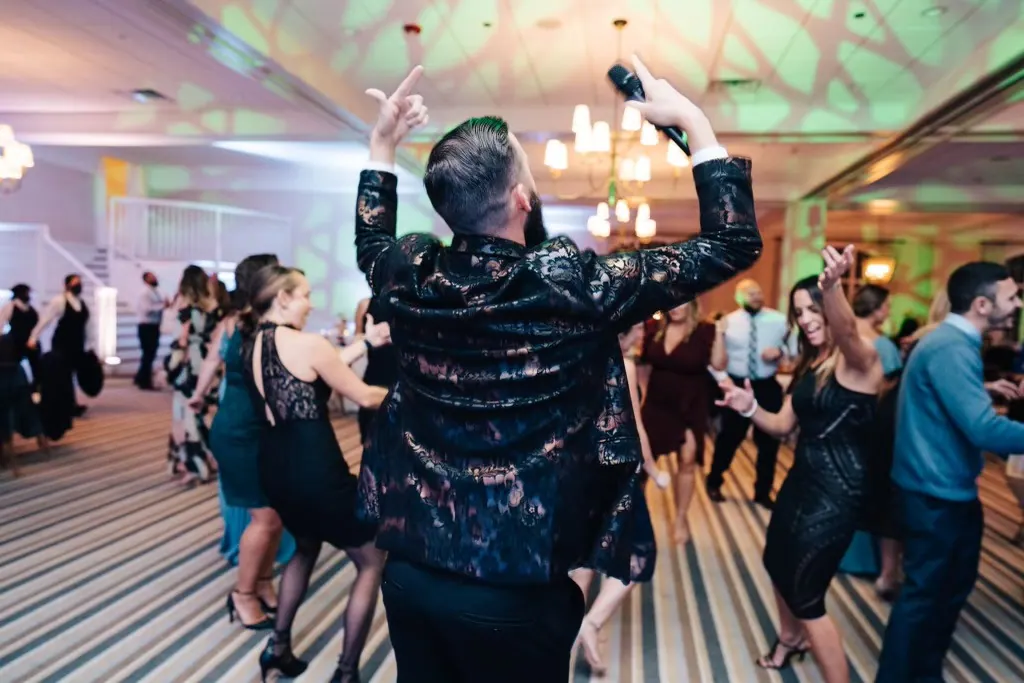
What Lighting and Effects Work Well for School Dances?
Lighting is one of the easiest ways to make a school gym, cafeteria, or rented hall feel like an actual event rather than a converted classroom. Intelligent dance-floor lighting that moves and changes with the music, combined with some uplighting around the room, does most of the heavy lifting without needing a full production budget.
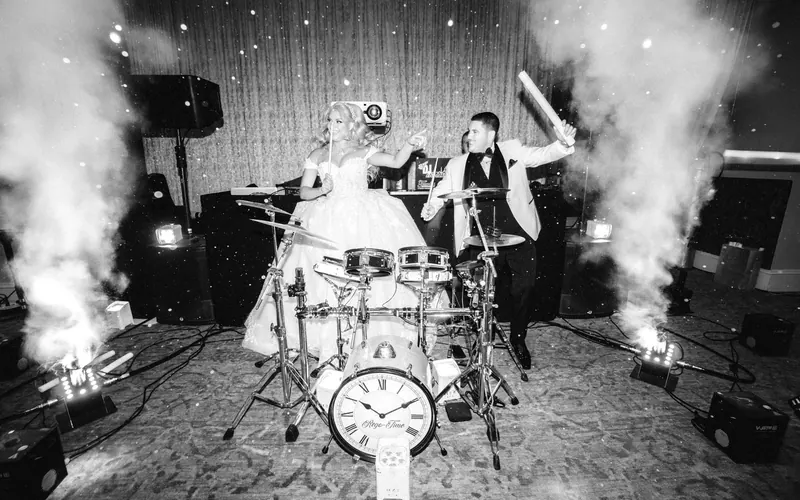
Effects like cold spark fountains or a low-lying cloud effect can create a memorable moment for a crowning or final dance, but indoor use still requires venue approval and compliance with applicable fire-safety rules. Cold spark and similar devices may be regulated by the local fire code and may require a permit or inspection, so schools should confirm requirements with the venue and local fire official.
Lighting Options for a School Dance
- Intelligent dance-floor lighting that syncs movement and color to the music
- Uplighting along walls to add color and depth to a gym or banquet room
- A custom monogram projection with the school name, class year, or dance theme
- TV displays for a photo slideshow or live social media feed during the dance
- Cold spark fountains for a big moment, pending fire marshal approval
What Fire and Safety Permits Do Schools Need for Dance Effects?
For special events on Monmouth County properties, the county fire marshal’s packet identifies tents, cooking operations, cold spark devices, fireworks, and other fire hazards as activities requiring a fire permit. Requirements elsewhere should be confirmed with the local fire official. Monmouth County’s Office of the Fire Marshal, for example, explicitly lists cold spark or similar devices among the items that trigger a special event fire permit and inspection, alongside tents, catering, and fireworks.
The Monmouth County Fire Marshal’s Office recommends beginning coordination as soon as the date and general event concept are confirmed to help avoid delays. If a school or venue is outside Monmouth County, the same logic applies: contact the local fire marshal’s office or building department early, well before the DJ load-in date, to confirm whether any planned effects need sign-off.
Beyond fire permits, New Jersey school districts are required to maintain a school safety and security plan, developed with input from law enforcement and emergency management, per the New Jersey Department of Education. A prom or dance should fit within that existing plan, including entry and exit procedures, chaperone coverage, and emergency response steps, rather than being treated as a one-off event outside normal school safety protocols.
A Short Safety Checklist for Dance Committees
- Confirm with the venue or local fire marshal whether cold spark effects or similar devices need a permit.
- Check the venue’s maximum occupancy and make sure chaperone counts match the expected attendance.
- Review exits, emergency lighting, and the school’s existing safety and security plan with administration.
- Confirm the DJ or production vendor carries backup equipment in case of an equipment failure.
- Walk the venue with the DJ ahead of time to confirm power access, load-in logistics, and sound limits.
How Should Schools Budget for Prom and Dance Entertainment?
School dance budgets vary widely depending on venue, entertainment package, and how much decoration and production a committee wants. Industry planning guides suggest DJ or live entertainment for a prom typically runs in a broad estimated range, with the final number shaped by hours of coverage, lighting add-ons, and whether a photo booth or videographer is included.
| Budget Level | Entertainment Scope | What’s Usually Included |
|---|---|---|
| Basic | DJ only, standard sound system | Music and MC announcements, minimal lighting |
| Mid-range | DJ with dance-floor lighting | Intelligent lighting, uplighting, wireless mic for announcements |
| Full production | DJ, lighting package, and photo booth or video coverage | Uplighting, monogram or theme projection, photo booth, TV display for slideshow |
Committees should always ask each vendor what is not included in the base price, since add-ons like extra hours, special effects, or an extra staff member for a second room can change the total quickly. FNA Events provides pricing by request rather than publishing flat rates; committees can use the contact page to request a quote for their specific dance.
DJ vs. Full Production: What Does a School Dance Actually Need?
Not every school dance needs a full production package. A smaller homecoming in a cafeteria with 150 students might only need a solid DJ, a wireless microphone, and basic uplighting to feel special. A senior prom at a hotel ballroom or banquet hall with 400 students, a court ceremony, and a theme, on the other hand, usually benefits from a fuller package: intelligent lighting, a monogram, maybe a photo booth for students to use between dances.
The honest answer is that scope should match the room and the moment, not the other way around. Overbuying production for a small gym dance wastes budget that could go toward better music variety or an extra chaperone stipend. Underbuying for a big formal in a large ballroom, by contrast, can leave the room feeling flat and the sound thin.
FNA Events’ school dance and prom entertainment page outlines the DJ and MC options available for schools in our service area, and our packages page breaks down how entertainment, lighting, and photo add-ons can be combined. For a wider look at what we offer beyond weddings, our events page covers private parties, mitzvahs, and corporate functions as well.
How Far in Advance Should a School Book a Prom DJ?
Popular dates fill up fast, especially Friday and Saturday nights in April, May, and June when proms cluster across New Jersey, New York, and Pennsylvania school districts. Schools should begin contacting DJs as soon as the date and venue are known, especially for spring dates or popular hotel and banquet venues.
Early booking also gives the committee time to finalize the do-not-play list, confirm lighting and effects choices, and coordinate any fire permit needs with the venue or local fire marshal’s office well before the week of the dance. Waiting until shortly before the dance may limit vendor and production options.
Schools in Ocean, Monmouth, and surrounding counties can see FNA Events’ full list of service areas to confirm coverage, and reach out through the contact page to check date availability for an upcoming prom or formal.
Frequently Asked Questions
Can a school DJ take live song requests from students during prom?
Most schools allow requests but have the DJ screen each one before it plays, rather than taking requests live without review. This keeps lyrics clean and avoids songs that conflict with the school’s do-not-play list. Agreeing on this process ahead of time prevents awkward moments on the dance floor.
Do cold spark machines need a permit at a school dance?
Requirements vary by jurisdiction and venue. The Monmouth County Fire Marshal’s Office, for example, lists cold spark or similar devices among the items requiring a special event fire permit, alongside tents and cooking operations. Schools should check with their local fire marshal or venue well before the event.
How many hours of DJ coverage does a typical prom need?
Prom schedules vary, and DJ coverage should account for the planned dancing time as well as setup and breakdown. Many DJ and MC teams offer coverage packages built around that window, with options to extend for a longer formal or a dance paired with dinner and a program.
Should a school hire a separate photo booth vendor or bundle it with the DJ?
Bundling a photo booth with the DJ and lighting vendor is often simpler for a committee to manage, since one point of contact handles setup, timing, and the day-of schedule. Separate vendors can work too, but the committee should confirm both are coordinating on arrival times and space needs.
What is a do-not-play list and why do schools need one?
A do-not-play list is a set of songs, artists, or themes the administration wants excluded from the dance, agreed upon before the event. It gives the DJ clear boundaries instead of relying on real-time judgment calls, which reduces the risk of an inappropriate song playing in front of students and chaperones.
Sources
- Monmouth County Office of the Fire Marshal: Special Event Fire Permit and Inspection Packet
- New Jersey Department of Education: School Safety and Security Plans
Ready to Check Your Date
If you are planning a wedding or celebration in New Jersey, New York, or the Philadelphia area, the FNA Events team can walk you through DJ and MC entertainment, photography, videography, live music, enhancements, and photo booths, all run by one coordinated crew. Call (844) 373-7411 or visit our contact page to share your date and venue and get pricing for your celebration.
Written by the team at Fresh New Angle Events, Toms River, New Jersey wedding DJs, photographers, videographers, and event professionals serving couples across New Jersey, New York, and the Philadelphia area.